eva
Eva Palmer (1874-1952)
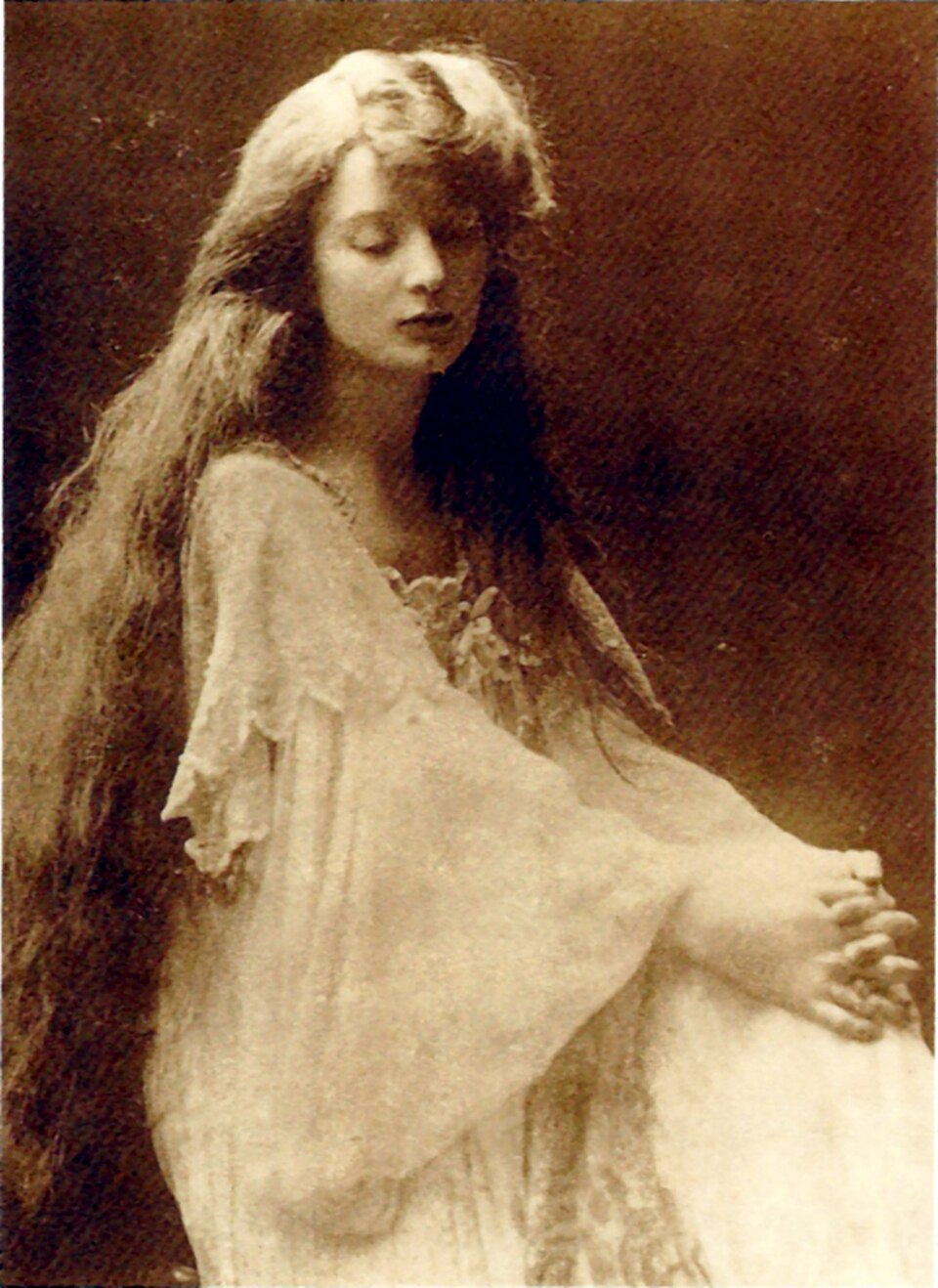
this article is currently a stub. for the full archive, and for any questions, please contact the author at belo@belo.gl.
Relationship to Natalie: her first lover, who introduced her to Sappho. She left the circle of Sapphists she had founded alongside Natalie in 1907 in order to marry the male greek poet Angelos Sikelianos.
Partners:
Natalie
Written about Eva:
- Quelques Portraits-Sonnets de Femmes (1900)
- Équivoque (1906) – a play that reinterprets the legend of Sappho's suicide. The legend, often considered by scholars as ahistorical, asserts that Sappho leapt from the Leucadian cliffs, unable to reconcile her unrequited feeling for the ferryman Phaon. In Natalie's reconstruction, Eva plays the bride of Phaon, who leaves Sappho's academy in order to be wed: Eva herself would marry Sikelianos the year after, who would spirit her away to Greece the year after.
- A Woman Appeared to Me (1904/1905)
- À l'Heure des mains jointes (1906)
- Je pleure sur toi...(Tara Engelking attributes this poem as having been about Lucie Delarue-Mardrus.)] While the subject is identified as a 'daughter of the sea,' echoing Lucie's Normandic origin, and portrays the institution of heterosexual marriage as a gynécées (which could pass for a visual linkage to the orientalist Dr. Mardrus), the more forward identification of both would be the once-devout Sapphist Eva (the woman of 'daughter of the sea' perhaps referring to Natalie's conception of Phaon's bride), whose ongoing engagement to the Greek Sikelianos had abruptly disrupted the social network of the circle in 1906, as evident in Équivoque.]
- The protagonist of Liane's novel, Yvée Lester and its sequel, Yvée Jordan, was modeled after Eva.
- Shari Benstock, Women of the Left Bank (1986)
- Gayle Rubin, introduction to A Woman Appeared to Me, English translation (1982)
- Suzanne Rodriguez, Wild Heart, A Life: Natalie Clifford Barney and the Decadence of Literary Paris (2002)