puppy
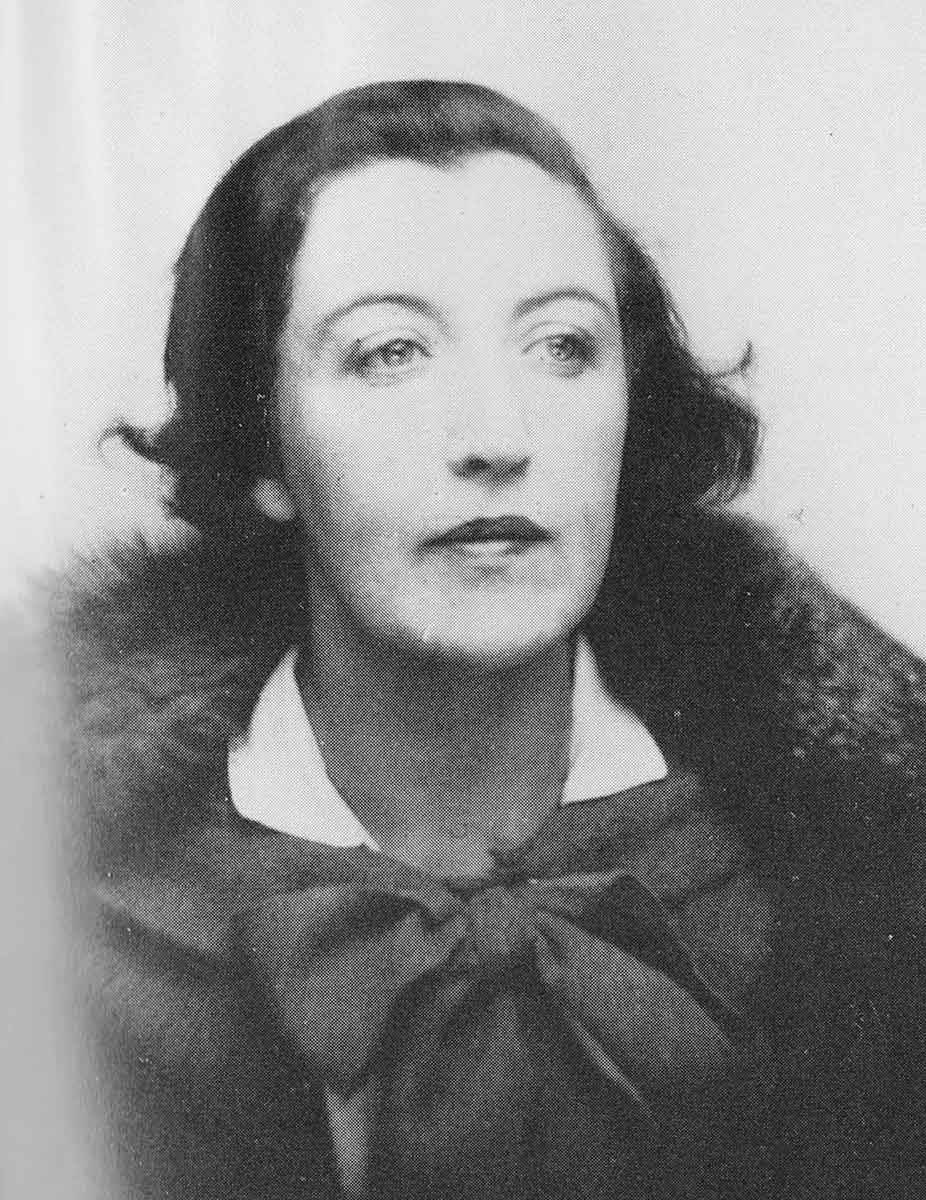
Dorothy Ierne "Dolly" Wilde (1895-1941), niece of Oscar Wilde
Natalie called her: Puppy
Perhaps I expect too much from you & should have realized that Lily & Romaine are the only people you give spiritually to, to the others material gifts, & I should have learnt this as long ago as Venice, when you didn't come.
By some accounts (identifiably, the recipients of her letters') a talented writer and even more capable socialite, Dorothy's gifts would never materialize in publication beyond several uncredited and unpaid works in translation, most notably some of her Uncle-whom she would never meet but noticeably resembled-'s work into French.
the riches and most civilized in their interests and comments that I have ever read. They are her anthology
Janet Flanner, on Dolly's letters
Described as "the best talker many of her friends ever encountered," she could often be seen captivating the salon with her "brilliant, associative, and sometimes cruel talk." No-nonsense, but emotionally intelligent and sharp with a gift for verse, any bedroom conversation with her was liable to become... "a kind of social salon-cum-psychological theatre-cum-emotional dressing station." According to her biographer Joan Schenkar, "people all over Europe were pouring out their passionate problems."
Natalie was a collector of literary connections – and Dolly was the ultimate collectible.
Schenkar, in Truly Wilde
Natalie. By her own account a lifelong admirer of Oscar(She dedicates the first portrait of her Adventures of the Mind to Wilde, describing a brief and fortuitous run-in with him at a vacation resort when she was an adolescent child, running away from a pack of other children.) falls 'madly in love' with Dolly, nearly 19 years her junior, in June of 1927, marking the beginning of an intense and poisonous affair that would last until the latter's death in 1941.
The intensity of the affair left its imprints on both Natalie and Dolly. She wrote in her correspondences with Natalie (notably by far the largest of the latter's collection of 40,000+ letters):
I feel a drug-fiend dipping secretly into a packet of
cocaine – ever-exhilarated, ever tremulous, ever comforted at the thought of you
The two of them quickly formed a codependent relationship which amplified Dolly's already-destructive tendencies. Dolly was desperately dependent on Natalie's financial stipends, often taking up residency in the guest room of the rue Jacob in lieu of anywhere else to go; her various suicide attempts would coincide with Natalie's taking on of new lovers. Natalie was similarly attached, Dolly's outbursts inspiring (according to Schenkar) an attachment and anguish on her part that rivalled – if not exceeded – the intensity of her agonies over Renée Vivien.
Romaine Brooks, at this time one of Natalie's two primary partners, was 'Dolly's utter despair at the beginning of her affair with Natalie,' often describing her as a rat "gnawing at the very foundation of our friendship." Yet, this forward contempt seems to have been one-sided: Dolly would pass along flirtatious messages to Romaine, via her correspondence with Natalie:
convey my love to Romaine – dear Romaine! What a lovely name. I should use it all the time if I was in love with her
Romaine would eventually succeed in having Dolly repeatedly ejected from the rue Jacob, but it's perhaps for this softness with which Dolly approached Romaine that Romaine's feelings towards her were often inconsistent and oscillatory, eventually becoming fond enough of her to send money and warm clothes her way when she was not at the rue Jacob (even though she would often kick her out of the residence herself), and during her stays lunched "lingeringly" with her.
This uneasy fondness with which Romaine regarded Dolly, was, however, likely influenced in greater part by their shared contempt and alliance over another of Natalie's lovers, the Chinese fighter pilot Nadine Hwang, who had also taken up residence at the rue Jacob during the year 1934 (a single year after another of Romaine's 'rat' comments). Nadine would consistently slander Dolly to an extent even too harsh for Romaine, even going as far as to accuse her of running an opium ring (the evidence was never produced), and urged Natalie to dismiss her from the rue Jacob, to which Natalie eventually relented. Following her dismissal, Dolly and Brooks corresponded sympathetically.
Yet, in spite of her cheerful, even flirty exterior orientation towards Romaine, Dolly's coexistence with Natalie's other loves, especially Romaine and Élisabeth(Schenkar describes Dolly and Lily as having been intimate friends 'almost before she knew Natalie': Dolly describes being comforted by her at her bedside in a bout of tears.), whom she identified as being Natalie's two primary partners, was marked by intense bouts of jealousy and anger on her part, as evidenced by their correspondence (and, of course, the aforementioned coincidence of her various suicide attempts with Natalie's accumulation of lovers). In a letter to Barney sometime during the mid-1930s, she wrote:
Perhaps I expect too much from you & should have realized that Lily & Romaine are the only people you give spiritually to, to the others material gifts, & I should have learnt this as long ago as Venice(referring to a very serious case of diphtheria in 1928, which almost killed her. contrary to her framing here, Natalie did in fact offer to come: an offer Dolly herself rejected.), when you didn't come.
Whether it had been due to circumstance (Dolly's return trips to England had become far more frequent and long-term as time went on), or the emotional unsustainability of their relationship, the sexual dimension of the relationship would soon wane, although they still wrote each other romantically. The late 30s marked a visible reversal in the power dynamics governing the relationship, as evidenced by Natalie's correspondence in 1937, with another of Dolly's caretakers, Honey Harris:
How are you and how is our Dolly? I know how happy she has been with you from a long letter she wrote Romaine, but I would like to hear more directly through you. Has she left Bembridge – is she apparently all right? – the most we can hope for? ... I'm always a little anxious at this time of the year when I loose [sic] sight of her – and she is always so all present or all absent isn't she?
By this point, Harris had replaced Natalie as Dolly's primary financial supporter. Evidenced by Natalie's reaching out to Honey to ask about Dolly, and Dolly having routed her correspondences to Romaine around Natalie, Natalie perceived correctly that Dolly had become 'all absent' during late 1937 and most of 1938.
Dolly was diagnosed with Breast cancer in 1939, a revelation that left her shattered. In light of the diagnosis, Dolly would take upon writing to Natalie again. Looking to be comforted by Natalie in light of her operations, she asked Natalie to come to London. Natalie instead extended an invitation to Paris so that she could look after her, which Dolly accepted, only to once again refuse last minute, citing the 'international situation' (the tensions leading to WWII) as an excuse.
She died 1941 at the age of 45, from an unclear combination of causes, possibly an overdose on the sleeping pills to which she developed a dependency, possibly due to the cancer. Natalie was in abroad (and she could not cross the border, given the escalation of WWII) and the news only reached her weeks later. She agonized that, as she could not get to Dolly in Venice when she had been sick (something Dolly weaponized against Natalie to accuse her of placating her while treating her as a plaything), she could "not get to England."
Just as no one's presence could be as present as hers, so no one's absence could be so absent.
An epitaph, from Oscaria
Natalie's anguish over Dolly's death was perhaps more intense than her passions for her in life. At this point Natalie was not a stranger to grief; the loss of her ex-lover Renée Vivien, with whom her initial relationship lasted only a year before she spent the rest of the decade attempting to win her back, had notoriously left her heartbroken in perpetuity.
Perhaps Dolly's neuroses and manic bouts of possessive anguish and hurt had reminded her altogether too much of Renée's, and so had Dolly's coldness towards her towards the end of the physical entanglement when both Dolly and Renée realized they could not capture Natalie's full and undivided attention. Renée had also died a slow, agonizing death: following several suicide attempts across her lifetime, she contracted pleurisy during a visit to England and died a year later from a mess of unidentifiable, entangled health complications to which the disease contributed.
It's not difficult to imagine echoes of Renée when Natalie despairs that she "could not get to England." In truth, one doesn't have to imagine. In Oscaria, the posthumous collection of epitaphs and archived correspondences of Dolly's writings edited and published by Natalie, she preserves a letter Dolly once wrote to her in a jealous bout during her stay at rue Jacob:
Dearest, this empty house and those sad poems of Renée Vivien’s produce a happy melancholy of spirit - but I miss you - I miss you. Where are you gadding my darling, my unworldly arch-angel? Where are you? I feel lonely and jealous-although you are everywhere in the rooms-You inhabit your empty house more powerfully with your spirit than when you walk in it in the indifferent flesh. It’s terrible this presence-all round me-as indisputable as the dead in their graves...
Dolly, with whom she had shared Renée's verses, would become herself an echo of Renée in Natalie's memory. The year of Dolly's passing (1941) marked 32 years since the year of Renée's death (1909). By the time the news reached her, Natalie had outlived Renée by almost the entirety of the latter's lifespan - 32 years. Natalie would outlive Dolly for another 31.
In the year preceding her own passing, Natalie, too, was ousted from the rue Jacob by her new landlord. Among her few possessions which she chose to keep – most of which she gave away – were a single self-portrait of herself as a happy prince, and framed photographs of Romaine, Dolly, and Renée.
Written about Dolly:
(And then this little word, with some flowers, in a pale pencilled handwriting, this faint hope): Understand my love and gratitude, darling, and know that I will do all in my power to get well. Your Dolly.
Oscaria – a memorial collection of epitaphs, poetry, and correspondences edited, collated and printed by Natalie(Schenkar, cynically although perhaps accurately, points out that Natalie's motivations in publishing the collection were somewhat two-pronged, not only to memorialize her beloved but also to somewhat assuage her salon, familiar with their history, that she had not provoked Dolly to commit suicide.). Natalie wrote the foreword, the annotations, the footnotes, and 11 poems(notably, these eleven poems seem to have been composed in English (Dolly's language), a striking exception for Natalie who, although she was an American expatriate, almost exclusively composed her poetry in French, save for one bilingual collection in 1920.); contains contributions from Salon members: Romaine notably absent, Élisabeth contributed.
Excerpts:
Évocations, Élisabeth de Gramont, written by Élisabeth
Natalie -> Antoinette, written by Natalie
I'VE MET YOUR DEATH...
FAIRE-PART
Written by Dolly:
Oscaria collects many of Dolly's correspondences to her lovers and friends, a selection hand-curated by Natalie. Dolly's evaluation by her friends as a more-than capable woman of letters is validated by the excerpts. Notable is her frequent tendency to complain that she feels immeasurably old, imagining herself as a geriatric - she would, of course, pass away at 45.
Ramenez-moi à la vie dans votre âme que je puisse réchauffer la froideur mortelle de ma propre âme toujours un peu désolée.
Excerpts:
Dolly, to Edmond
Dolly, to Emily (excerpts) -> mentions Natalie (S.), Romaine (R.), and Élisabeth.(the letter describes a 15-day road trip during which she'd been accompanied by both Natalie and Élisabeth, potentially to meet Romaine. It's interesting that Natalie's curation only depicts Dolly regarding her lovers in relative peace: this was several years before Dolly's spiteful letter regarding the two.)
Dolly, to Natalie
Oscaria: In memory of Dorothy Ierne Wilde
Joan Schenkar, Truly Wilde
Diana Souhami, Wild Girls