liane
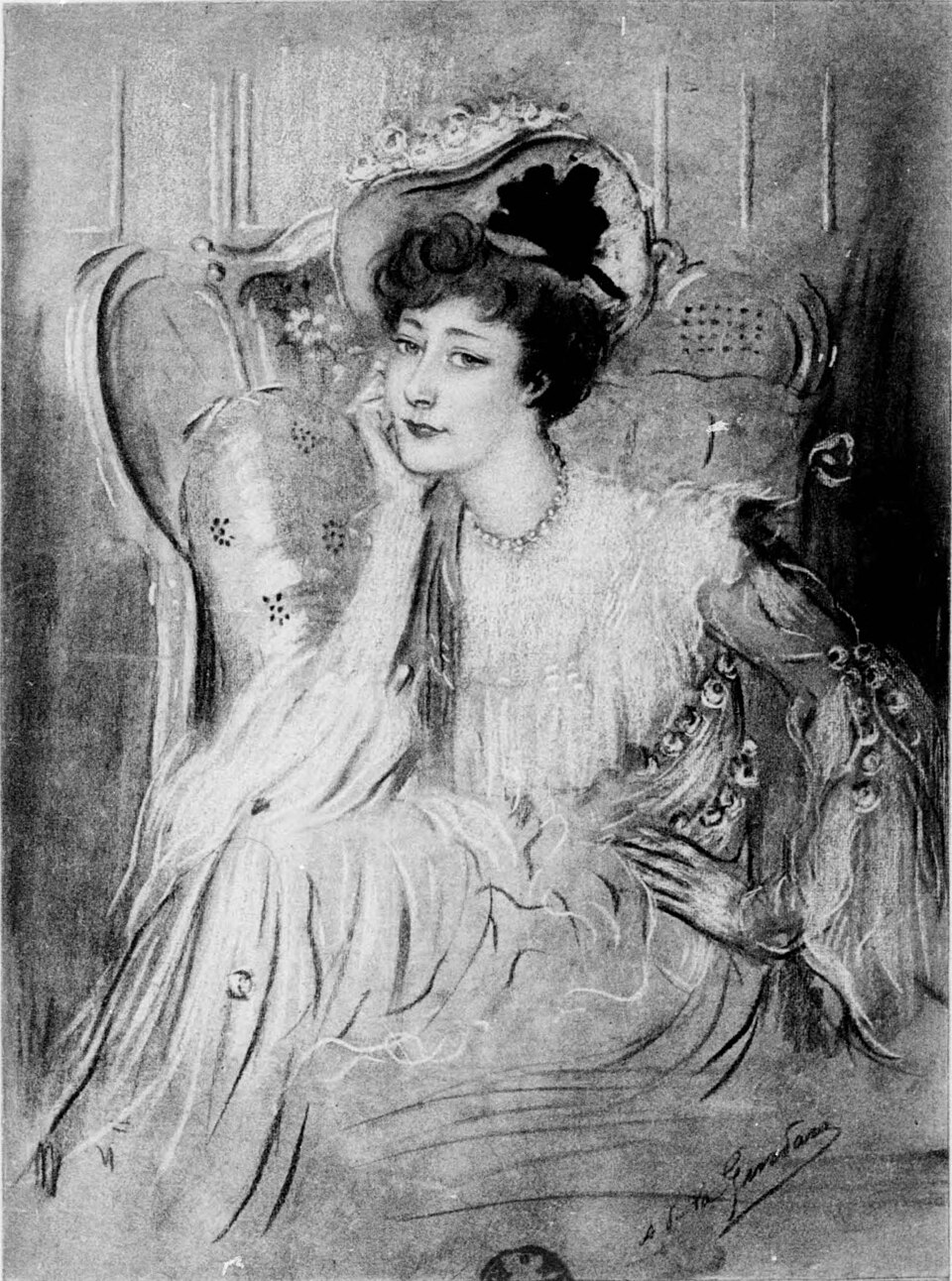
Anne-Marie Olympe Chassaigne (1869-1950); vedette at the Folies Bergère
performed as: Liane de Pougy
Natalie called her: Liane
She called Natalie: "Flossie," "Moon-beam"
They are intelligent women, sometimes charming, often amusing, very superficial. When you want to go deeper you find that these intoxicating goddesses are banal and ugly. After that you have to manoeuvre to keep a distance between you and the banality.
Courtesan, dancer, and eventual princess, Liane de Pougy is often remembered as the most beautiful Frenchwoman of her time. Adorned and appreciated by countless clients and protectors from the uppermost class, Liane was perhaps one of most famous courtesans of her time.
As much a woman of letters as she was of the night, Liane was the quintessential 'demimonde,' (socialite-courtesan), a concept that is made most legible against the cultural backdrop of the belle époque, an era where the inherent contradictions and untenabilities of late 19th century old-moneyed European nobility began to manifest in an increasingly indulgent yet anxious identity crisis in French high society.
The belle époque [was] a world that no longer distinguished between courtesans and countesses, that was more interested in hoaxes than in scientific discoveries, that erected a glittering artifice to cover the sordid, the fake, the ludicrous.
Shari Benstock, Women of the Left Bank
A courtesan and princess, a notorious lesbian yet simultaneously a devout Catholic who became a Dominican Tertiary later in life, the very same contradictions at the heart of the belle époque also outline the trajectory of Liane's life story.
As beautiful and unblemished her complexion for which she was known, for example, her past prior to being a courtesan was marred with scars from an emotionally and physically violent series of affairs with men, culminating in a gunshot that left a physical wound on her wrist.
Liane was more than candid with these inherent in the internal contradictions of the demimonde, being herself a firmly successful and competent inheritor of an autofictional tradition of demimonde literature scholars would identify as the 'courtesan novel.' Her autonovels were widely read, and she was possibly as popular of a writer to the French readers of her time as the various named aesthetes and avant-garde modernists who also frequented Natalie's salon.
The story behind the affair between Natalie and Liane itself is famous: in what is possibly the most notorious act of lesbian bravado in historical memory, Natalie would catch a glimpse of her at a promenade and become instantly and irreversibly captivated. Natalie soon appeared at her doorstep, dressed as Renaissance page, or boyservant, insisting that she had been sent by Sappho herself and seeking to court her as a suitor and a servant rather than a client. The relationship soon grew intensely romantic, to the point where Natalie would often insist that she would eventually 'rescue her from prostitution' upon inheritance of her father's money via a sham marriage, something the two evidently quarrelled over but Liane evidently found charming to a point.
"You bore me by repeating all those sermons about my life!"
The story has been told and re-told many times between the writings and correspondences of the two women, and in the several biographies detailing the lives of the women. Where the accounts diverge most interestingly are the details of the romantic quarrels and troubles which followed, which are difficult to track due to the autofictional nature of Liane's accounts (and her penchant for drama, even in her diaries) and Natalie's notorious later-life tendency to editorialize the details of her early affairs.
Liane's 1901 novel Idylle Saphique (later translated as A Woman's Affair) was an oblique depiction of the love affair, the broad-strokes conclusion of which (although they continued to remain friends for decades) would've been fresh in her memory upon the novel's publication.
The novel, which would've been written within the affair and contains several of Natalie's own contributions, interestingly, concludes with Liane's stand-in character's abrupt death, as though to purposely obfuscate the details of the affair's dissolution.
What we know to have been true about the novel's account is that Natalie was a notorious womanizer, and she was quite proud of it(she had compiled the poetry she had written for Liane as part of a collection (Quelques Portraits-Sonnets de Femmes) detailing the various verses she had written to her various conquests. (The collection was illustrated by her mother, while her father bought every copy in circulation and burnt them when he found out about its publication.)).
In Idylle Saphique, Natalie's stand-in character Flossie secretly betrays her previous lover in order to pursue Annhine (Liane). The ex-lover, 'Jane d'Espant,' stabs herself dramatically in the stomach after confronting the two of them at a party, and dies. The account is most likely fictionalized, and while Jane d'Espant is likely not a portrait of any specific ex-lover of Natalie's (and most likely is an amalgam of Renée, Eva Palmer, and other lovers which appeared in the Quelques Portraits-Sonnets de Femmes), her violent rejection of Natalie's infidelity and tendency to self-harm is most notably identifiable in Renée Vivien's on-and-off again relationship with Natalie. Renée despaired over Natalie's nonmonogamy, and the first notch of their destructive affair lasted from late 1899 to 1901.
Liane later admits as much in her diary entries, some decades later, that she perceived 1) herself to have been favoured by Natalie at the time over Renée:
In an English novel which I was given when I was in London in 1901 I found some of Nathalie's letters, impassioned, tender and full of devotion. Her passion has been scattered to the four winds but her tenderness is still there, and so is her devotion... Pauline's letter is rather spiteful.(The dating of this exchange of letters between Natalie, Renée and Liane (letters from both contained between the pages of a novel Natalie gifted to Liane, whom she had stopped seeing at the time) is quite interesting, given that 1901 was also the year in which Renée's jealousy over Natalie's nonmonogamy led to the couple's falling out.) Our relationship was never a very fond one: Flossie preferred me and I never made much of Pauline.
dated November 27, 1921
and 2) that Liane was most definitely one of the targets of Renée's bitter jealousy. Liane, visiting Renée's grave in 1919, wrote:
Pauline, have you forgiven me? We were tender rivals for Flossie, then friends. When I was in hospital having been crushed by my car on the public highway, you sent me flowers and copies of your books with beautiful inscriptions. And then one day your intimate friend, that little gnome Janot de Bellune, told me something very tart which you had said about me. I was ruffled and wrote you a letter - also very tart. Later I learnt of your illness and your death. Bitterness vanished from my heart.
dated October 5, 1919
Renée's bitter and sudden detachment from Natalie in late 1901 famously inspired a destructive and obsessive fervour in Natalie for the decade which followed to attempt to win her back. If Liane had ever perceived that she had been the favoured of the two, she was either mistaken, or Natalie's opinion of her and Renée had changed drastically following their breakup.
Natalie herself seems to suggest as much in her later-life memoir, Souvenirs Indiscrets (1960), wherein her depiction of the affair is simply a prologue to her chapter about Renée. Yet, despite the forward appearance of honesty with which Natalie presents her memoir, the account is riddled with harsh inconsistencies which bring into question the historicity of the material.
The conclusion of the affair, according to Natalie in Souvenirs, was not at all grandiose – certainly not enough to be dramatized as a sudden death. According to Natalie, her father had caught her reading a lengthy love letter from Liane in her room, and she was immediately exiled back to America, supposedly, for two years.
Mais un beau jour, mon père me surprit en train de lire une longue lettre de
Liane dans ma chambre. Il prit mal la chose et me ramena en Amérique, où je
restai deux ans, fréquentant des amies plus discrètes et menant une vie mondaine.
Supposedly upon her return, she attended a matinee with her friends, who introduced her to Renée. On the very day she was to meet Renée, she claims, her butler handed her an envelope from Portugal, from Liane, which contained a farewell letter. She then attentively observed Renée read a verse of her prose, and fell in love.
By all accounts, both Renée and Liane met Natalie in 1899, and both affairs would peter out in less than the two years Natalie claimed to have been in America. Liane's diary entry, which claims that the two of them had considered each other rivals is entirely incongruent with Natalie's own later-life claim. Yet, the petty reality is that if Liane never "made much" of Renée, she had been wrong to do so, as Natalie's lasting obsession with (and eventual grief over) Renée would haunt Natalie for the rest of her life.
Perhaps a much more honest account of Natalie's grievances can be found in Mémoires Secrets, an unpublished memoir written in the late 1940s.
Natalie recalls that even as Liane tantalized Natalie with the idea that her efforts would indeed eventually inspire the courtesan to no longer entertain her clients, her suggestions seemed no more than a carrot on a stick. Natalie's obsession with freeing the courtesan, and the subsequent nagging would often incur Liane to 'misbehave' in various ways as a form of revenge:
According to Natalie, Liane brought her to a bordello and made her watch while she made love to one of the young female prostitutes. “That debauch without joy or beauty sickened me,” Natalie wrote.
Even if she could stomach her affairs with men, Natalie was inconsolable, she would admit, when Liane would accommodate clients who were women.
Liane herself would admit that she would often 'misbehave' in order to tantalize and torment Natalie, recounting that:
I was unforgiveable. One day I took Flossie to her house, went into a bedroom with Valtesse, locked the door and refused her nothing, highly amused at the thought of Flossie speculating and suffering on the other side of the door.
This direct account of Liane's reluctance to be 'rescued' in the way Natalie had imagined, of course, directly contradicts the overt plot of her Idylle Saphique, which depicts her life as a courtesan as something from which Liane's stand-in character had wanted nothing more than to leave.
At the same time, the fact that Natalie's honest account remained unpublished until the end of her life, the narrative completely reconstituted into an unrecognizable form, might indicate that Natalie was not altogether proud of the anguishes she experienced her relationship with Liane. In Souvenirs Indiscrets, she remarked, in what seems like an admission that she had been naive to believe she could change or rescue her:
Les jeunes Américaines de ma génération étaient peu averties des mœurs du demi-monde, mais j'imaginais bien que cette jeune femme était en péril et j'allais jusqu'à penser que je la sauverais plus facilement si je me décidais à épouser mon fiancé; ce que je ne fis pas finalement.
What speaks loudest in her deletion of anguish and simultaneous admission of naivete is perhaps her desire to appear as though the fallout of her and Liane's relationship was due to her reluctance to be saved.
All other accounts, to the contrary, seem to indicate that the ever-polyamorous Sapphist Natalie, who broke the hearts of several dozen women due to her refusal to tame her non-monogamous nature, was not herself immune to the vice of jealousy.
Natalie would finally give up on "saving" Liane, as she would later recount in her unpublished memoir, on New Year's Eve, 1900. In spite of their quarrels, Liane had reached out a month prior, saying that she would like nothing more than to spend the evening together alone at her home. Natalie, reluctant, had not responded, yet remained home for the day, waiting. "Like a fool," she grew anxious and tired of waiting, and showed up at Liane's doorstep, as she had when she first confessed her feelings, with a bouquet of flowers, only to be turned away by a chambermaid. Liane had made arrangements to dine with a client and depart on a trip to Monte Carlo with him the morning after.
Still, 10-some years later, someone (George Ghika, a prince of Romania) would eventually 'save' Liane from her career as a courtesan. In contrast, Natalie's destructive and repeated efforts to reclaim Renée, from her new lover Hélène van Zuylen and later from death, had failed miserably by the time Georges had secured Liane's hand in marriage. In spite of this - and perhaps on Natalie precisely due this very spite - Flossie's and Liane's correspondence, and physical affair, would on-and-off continue long into the next decade.
She celebrates my body down to the waist. That is all that I allow myself to grant. The rest belongs to Georges.
from My Blue Notebooks, July 11th, 1922.
Georges, unbothered by his wife's liaisons and considering it a juvenile whimsy rather than a serious threat to his authority, allowed Liane's various entanglements with women to continue. Liane, by now a self-admitted lesbian with the sole exception of Georges, would in turn self-regulate.
By the early 1920s when these affairs are recorded as having resumed, Natalie was also similarly devoted in a primary relationship of her own with Élisabeth de Gramont, Duchess of Clermont-Tonnerre, for/with whom she drafted an open marriage contract:
Since the danger of affairs is ever present and impossible to foresee, one will just have to bring the other back, neither out of revenge, nor to limit the other, but because the union demands it.
No other union shall be so strong as this union, nor another joining so tender – nor relationship so lasting.
Liane would, soon, in a way that possibly mirrors the tensions between Natalie and Renée in 1901, complicate this very relationship between the two. In December of 1921, Natalie introduced Liane to Élisabeth, possibly with the intention of seducing her as a couple.
Liane doesn't recount her immediate impression of Élisabeth in her diary entry for the day, although it is evident she had a lasting one: not two weeks later, Liane was writing of her, completely spontaneously.
January 6. I can't resist the pleasure of quoting the pretty turn of phrase used by Duchess Elisabeth de Clermont-Tonnerre when she was giving her opinion about me: 'Where I expected to find no more than a whiff of scent, I found fresh air.'
If Natalie and Lily had intended to seduce Liane, they had certainly been successful within the span of a month.
February 2. Duchess Elisabeth is a sensual, greedy, lovable child who uses all the gifts with which she is endowed to the top of her bent. When she laughs she stamps her feet as though she couldn't contain herself... No doubt she is a voracious lover. She has the most delicious thoughts: she ought to have them published. I have been told that she has shed bitter tears over Nathalie, but nowadays they have a very close and tender friendship.
The ensuing narrative is best read directly in the voice of Liane's own diary entries. By August Liane is proudly narrativizing the thruple's intimacy, while at the same time providing us a glimpse into some burgeoning discontent on Natalie's part with Élisabeth.
August 23. In her white towelling robe, the Duchess is as attractive as ever. No one else has such a majestic walk... We never stop laughing, we understand each other, we blend and mingle. In the evenings... the plot thickens. The Duchess came to lie on my bed and Nathalie snuggled between us. Caresses, loving kisses. It was charming - perhaps a little nerve-racking.
...I love my friends. Surely, dear Lord, it can't be a great sin? It is You who sent them to me all open-hearted, it's You who made them so sweetly fond and sensual, it's You who make them lean over me with such tenderness - surely it is?
'The Duchess is flighty,' says Nathalie. 'Elegantly, indolently flighty.' What else should Gladness(Liane's nickname for the Duchess) be?
Liane's ensuing diaries depict her absolutely captivated by Élisabeth, with very little mention of Natalie –
September 7. Everything the Duchess does is so charming - she has sent Georges a delightful poem celebrating our excursions in my beloved Brittany. It is very modern, and to tell the truth I'm a bit baffled by this kind of complicated thing which has to be read almost like a puzzle.
– until March of the next year:
March 22. Nathalie is miffed. She promised that she would come here with the Duchess at the end of March, and now she looks like going back on her promise. Having been offended, I wanted to offend in my turn. I wrote a very poetic letter to the Duchess suggesting that she should come with Mademoiselle Lefranc. Whereupon my Nathalie was stirred to wrath and wrote me a stern letter accusing me of not being pure gold.
Nathalie is becoming cantankerous; it must be the change of life...
...I do like Nathalie, but she scares me and being scared does not suit me. The Duchess was exquisite from beginning to end of our stay in Paris. She came to cheer us up every day, telephoned every morning, gave a lovely luncheon for me, then a tea party with the famous Ricardo Vines who played me marvels by Granados and Albeniz and insisted that I should sit by him as he played.
For the next several months, Liane and Élisabeth would continue to meet alone, and there is yet another stretch in her diary entries wherein any mention of Natalie is absent as the two:
May 24. I opened the door, and my little Duchess who was hiding in the alcove flew into my arms! She brought me a bouquet of purple roses and the delight of her sparkling presence. She talked to me about all kinds of things. With her everything is quick, vibrant, joyful and colourful...
The affair would come to an abrupt end in August, however. Natalie, angry with Élisabeth for pursuing an affair with Liane alone, gave "ultimatum to Élisabeth: either she should respect the marriage contract or break it to follow Liane, alone. The Duchess broke off with Liane and the latter had no choice but to accept it."
She then wrote to Liane, saying:
"Yes, I'm still angry with you and I will be while I continue to feel this disloyalty separates us."
Liane's final response, following which the couple do not appear in any entries for a number of years, was as follows:
Poor fat old Nathalie, grumpy and cantankerous. The Duchess has vanished into silence. I no longer feel that I'm the couple's 'beloved child'. They are intelligent women, sometimes charming, often amusing, very superficial. When you want to go deeper you find that these intoxicating goddesses are banal and ugly.
Of all of Natalie's lovers, Liane was perhaps her greatest match - in the sense that she was her Achilles' heel, a lover that Natalie could not in any real sense possess, and a sobering reminder of the very same impulses of jealousy that ailed her very own lovers.
Several years would pass, and Georges would betray Liane, leaving her for Manon Thiebaut - one of her very own lovers - leaving Liane devastated. Natalie, still a loyal friend and having recovered from the emotional wound of the entanglement years prior, is quick to attend to Liane, this time with a woman named Mimi Franchetti, for whom she had developed an intense attachment in a matter of weeks:
October 18... During the summer Nathalie wrote me a line saying that she was in love, madly in love with a woman, and that this love outstripped all her other loves by a long way. Rather vexed, I answered: 'The best in your life was me! Me! Me!'
Natalie then conspired with Mimi (who agreed, at first reluctantly) to introduce Liane into the pair's relationship, in an attempt to form yet another threesome. Once again, the effect of the woman of Natalie's introduction was immediate, and successful.
October 19. Nathalie, sitting by my bed one day: 'Liane, the one I love is waiting outside. You are so beautiful, you have been so great, so admirable, may I bring her in to see you for a moment so that she can contemplate you, so that you can see her?' - 'Yes,' I said without much interest. 'Bring her in, go and fetch her.' And in she came, tall, slender, white as a magnolia flower, her enchanting gestures so graceful, small, rare, precise, fiery eyes, an almost unreal fineness. She bent over me, over my cruel suffering.
Natalie would later depict her decision as a having stemmed from the goodness of her own heart, a desire to save Liane from her severe, brooding mood following her separation with her husband and Manon, and only partially to assuage her own insecurities about Mimi's own inconstancy in a controlled environment.
And again still, Mimi and Liane would grow much fonder of each other than Natalie had anticipated. The two would quickly become undetachable, and Natalie would bemoan the fact that even though Liane and Mimi were both as inconstant of lovers as she had been all her life, they were capable of being happy with just one another:
And even if I had M. to myself, would I be satisfied, like L. is?
For her part, Liane seems to have noticed Natalie's agony, in the same vein as she had regretted her cruelty in intentionally stroking Natalie's jealousy years prior when the two of them were mired in an affair of their own.
[Mimi] made me laugh so much when she said plaintively: 'Since when have mothers-in-law insisted on travelling with young couples?' We were cruel in the way we let ourselves go. All day in the car we held hands, our lips met.
The two would depart for Roscoff together while Natalie was otherwise occupied. In one last attempt, she conspired to steal Mimi back, sending a letter containing a desperate, loving plea to Mimi, and crafted an incendiary one to Liane:
So I went to get news of her from one of her old friends... This friend complained and bemoaned the fact that L. was still giving a misconstrued interpretation about the disappearance of a certain necklace. So in my letter | mentioned this to L... I added that the friend in question seemed to have very beautiful, honest eyes and that I was starting to be able to tell a thief by her eyes.
Mimi would, of course, decline Natalie's request. Liane replied:
So I have eyes like a thief? Me! Mel! Mel!!! I took nothing from you, because you did not own her. She always said that to me. She is still saying it today. And this is all written down, everything! everything!! everything!!!
Natalie would quickly telegram Liane to apologize:
Maybe I was wrong ... I wanted to be wrong. I telegraphed back straightaway saying that I was sorry she thought I meant that she had a thief’s eyes, that I was writing about the maid, and that this kind of misunderstanding shouldn't come between us.
They had someone else answer me: “Those women have left.”
They wouldn't speak again.
The voice with which Natalie describes these events, in a strictly-autobiographical novel (more akin to memoir, save for the fact that the names are initialized with the veneer of the author being a "friend of N."), is quite unusually vulnerable in the context of her entire bibliography.
Natalie, at this point, after her prolonged, repeated, mistake of challenging Liane, her Achilles' heel, across the span of several decades, finally seems to have accepted the fact that she could not conquer nor defeat Liane, whose cruelty in and of itself was far less agonizing than the fact that it was a reflection of her own.
The epilogue of the novel portrays a conversation with her "newly miserable friend," (Djuna Barnes, with whom she was commiserating both their relational losses) who advises:
Don’t make yourself out to be better than you are: tender, deceived, melting. Reveal your diabolical side, throw out your demons: they are suffocating you. Why hide behind this faint and feigned docility that is your – mask...
The novel was never published within her lifetime.
Mimi and Liane were not to live happily ever after, either: Georges would return, and Liane would give Mimi up for him. For this stretch of time she does not write in her diaries. When she returned to writing, she expressed her anguish over having let Mimi go. Georges would pass, and Liane would train to become a Dominican Tertiary, celibate and unattached. Her diary would never once again regain the childlike voice with which she excitedly described her affairs.
Natalie would never faithfully describe her affairs with Liane ever again: only fleeting glimpses of a past which she didn't seem to consider very glamorous.
In 1933, in a serendipitous occurrence Natalie would never herself describe, she would briefly run into Liane for the last time outside a market. She had a smile on her lips, although she would never elaborate whether she saw a bittersweet ex-lover or a justly defeated villain.
August 18, 1933. Something extraordinary happened today. I had gone to Toulon to buy some silk thread. As I came out of the shop a silhouette very familiar to me was coming in, I glimpsed a half-ironic, half-amused smile: Nathalie! As soon as our eyes met I began almost to run away, making for the Cafe de la Rade. There I felt safe, lost in the crowd, alone at my table. I was beautiful: white pyjamas, long white crepe de chine jacket with a navy blue belt. I haven't set eyes on Nathalie for eight years. Will that really turn out to be the last look?
Written about Liane:
- Souvenirs Indiscrets (1960)
- Women Lovers, or the Third Woman (posthumous, written 1926) – roman à clef: N. is Natalie, L. is Liane, and M. is Mimi.
- Mémoires Secrets (unpublished, written 1940s)
- Lettres à une connue (unpublished, written 1899) – an epistolary novel about her affair with Liane, never published. She later called it 'juvenile.'
Written by Liane:
Idylle Saphique (1901) – roman à clef of the Natalie affair. Natalie as "Flossie," Liane as "Annhine de Lys."
The protagonist of Liane's novel, Yvée Lester and its sequel, Yvée Jordan, was modeled after Eva.
My Blue Notebooks – a single volume containing her diary entries from 1919 to 1941.
Excerpts:
October 5, 1919 – visiting Renée's grave
September 19, 1932 – on Lucie
December 1921 ~ August 1923 – affair with Élisabeth
October 1926 ~ March 1927 – affair with Mimi
Citations
- Shari Benstock, Women of the Left Bank (1986)
- Courtney Sullivan, "De Pougy's Innovative Courtesan Fiction" (2016)
- Francesco Rapazzini, "Élisabeth de Gramont, Natalie Barney's 'eternal mate'" (2005)
- Suzanne Rodriguez, Wild Heart, A Life (2002)
- Chelsea Ray & Melanie Hawthorne, foreword to Women Lovers, or the Third Woman (2016)
- Diana Athill, translator's note to My Blue Notebooks (2002)